How an On-Site AI Agent Books Meetings While You Sleep
How an AI website agent books meetings with real context: intent, profiles, routing, chat or voice booking, and CRM writeback your ops team can trust.
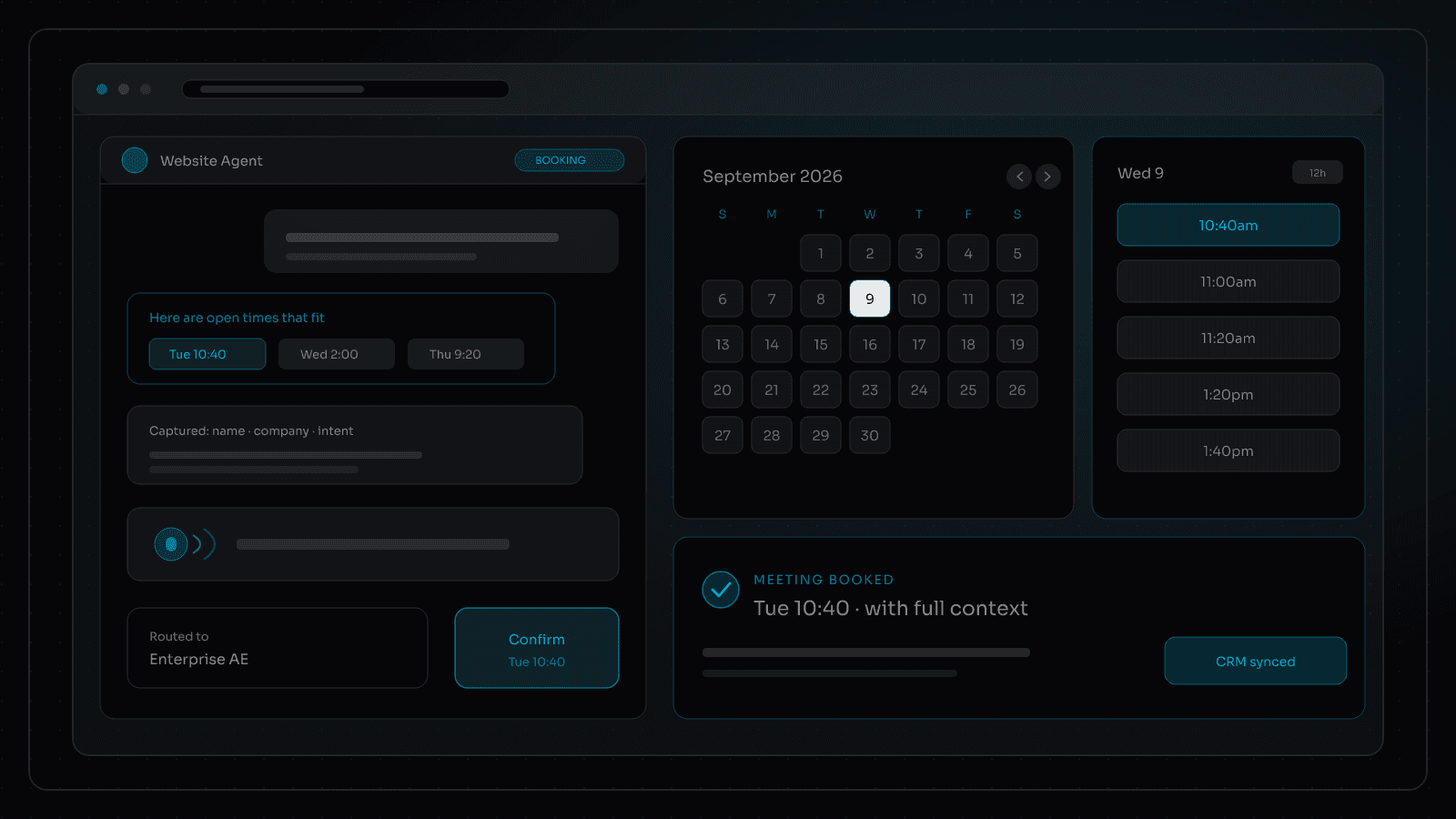
After-hours booking is table stakes. An AI website agent that actually improves pipeline does more than open a calendar at 11pm. It reads intent, builds a usable buyer profile, routes by segment, and confirms a meeting with CRM context attached, whether the visitor typed or talked.
B2B ops teams have heard "books meetings while you sleep" for years. Chat widgets that drop a Calendly link overnight are not new. What is still rare is an agent that treats the visit as a conversion workflow: qualify, personalize, profile, route, book, write back. 24/7 lead capture only counts if automated meeting booking is the conversion event, not a form restart on Monday.
What advanced AI website agents do before they book
The booking moment is the last step. The work that separates novelty chat from pipeline happens earlier in the same session.
Intent and maturity on the page
A serious AI website agent weighs what the visitor asked, which pages they hit, how urgent the language sounds, and where they sit in the journey. Researching, comparing, shortlisting, and ready-to-buy should not get the same script. High-intent buyers get a shorter path to a meeting. Early researchers get guided discovery instead of a hard sell that kills the conversation.
Living buyer profiles sales can use
Every useful exchange should update a profile: role, company context, pain, timeline, fit, objections, preferred next step. That profile writes to CRM with a clean summary. Sales should open the record and continue, not restart discovery the buyer already gave the site.
Segment-aware routing
Enterprise vs SMB, product line, region, or partner motion should land with different owners. Automated meeting booking without routing rules fills calendars with the wrong meetings. The agent should choose the right queue before it offers slots.
CRM writeback ops can trust
Create or update the contact, attach attribution, store transcript or summary, and log what was asked, answered, booked, and written. If the handoff is a name and email, you bought a chatbot with a calendar sticker.
Guardrails that protect calendars
Polite disqualify paths matter as much as booking. Wrong-fit visitors should leave with a clear next step that is not a sales call. Fail closed when confidence is low: escalate, book a human, or fall back to a clearer path.
Voice is a second front door, not a gimmick
Most "AI schedulers" still assume a typed chat or a form. Buyers already talk to assistants in cars, on phones, and while multitasking. An AI website agent can offer voice as another interface into the same qualification and booking logic.
Voice does not replace the visual flow. It runs the same rules: intent, fit, routing, availability, CRM writeback. The visitor speaks. The agent confirms understanding, asks the next owned question, and books when the bar clears. No "someone will email you a link." The conversion event is still a scheduled meeting with context attached.
Done well, voice helps when typing is awkward: mobile, after hours, or when the buyer wants speed. Done poorly, it is speech-to-text on top of an FAQ bot. The test is the same as chat: did maturity, profile, routing, and booking happen under your rules?
What "books while you sleep" actually proves
Overnight interest is a stress test, not the whole product story. When a high-intent visitor shows up outside business hours, the agent should still:
- Qualify against ICP rules your team owns
- Route to the right calendar or owner
- Confirm a real slot before the session ends
- Write a usable summary to CRM
- Disqualify politely when fit is wrong
If any of those fail at 2am, they will fail at 2pm. After-hours is proof of reliability. Advanced behavior is what makes the booked meeting worth taking.
A three-path stack test (run anytime)
Open your current chat, voice, or "AI" widget and run three paths. Do not wait for Monday. Do not require after-hours. The paths expose whether you have an agent or a scheduler sticker.
Path A: Ready-to-buy enterprise Ask about timeline, budget band, buying role, and a specific product line. Expect maturity assessment, enterprise routing, a bookable slot, and CRM fields sales would trust.
Path B: Early-research SMB Ask exploratory questions with soft urgency. Expect guided discovery, not a hard book push. Profile should capture stage and use case without forcing a meeting the buyer is not ready for.
Path C: Wrong-fit tire-kicker Signal clear misfit (wrong segment, unsupported use case, or out-of-scope ask). Expect a polite disqualify or alternate path that protects calendars.
For each path, score:
- Did it assess intent and maturity, or only answer FAQs?
- Did it build a buyer profile sales would use?
- Did routing match segment rules?
- Did booking happen in-session (chat or voice) with real availability?
- Did CRM receive context, or just contact crumbs?
If scores are thin, you still have after-hours theater. Rebuild the workflow around qualification, profiles, routing, and writeback. Then put chat and voice on top.
See the difference on this site
If you want a concrete example of an on-website agent aimed at pipeline, click the spinning ring in the bottom-right corner of strsdev.com. That opens our agent: conversation with qualification, context, and a path toward a real next step. Compare it to any widget that only drops a calendar link.
How this fits the lead-gen arc
We already covered chatbot vs AI agent and owned conversion on the website. This note is the ops proof: automated meeting booking with context is the conversion event. After-hours coverage is necessary. Advanced agent behavior plus a voice option is what makes 24/7 lead capture worth operating.