Fixing the Website Change Request Bottleneck
A website change request process fails when asks live in Slack and email with no owner. Build a simple system, then keep a human moving the work.
A website change request is simple in real talk: someone needs something on the site to change.
New headline. Updated pricing. A landing page for next week's campaign. A redirect for an old offer. The work is often small. The wait is not.
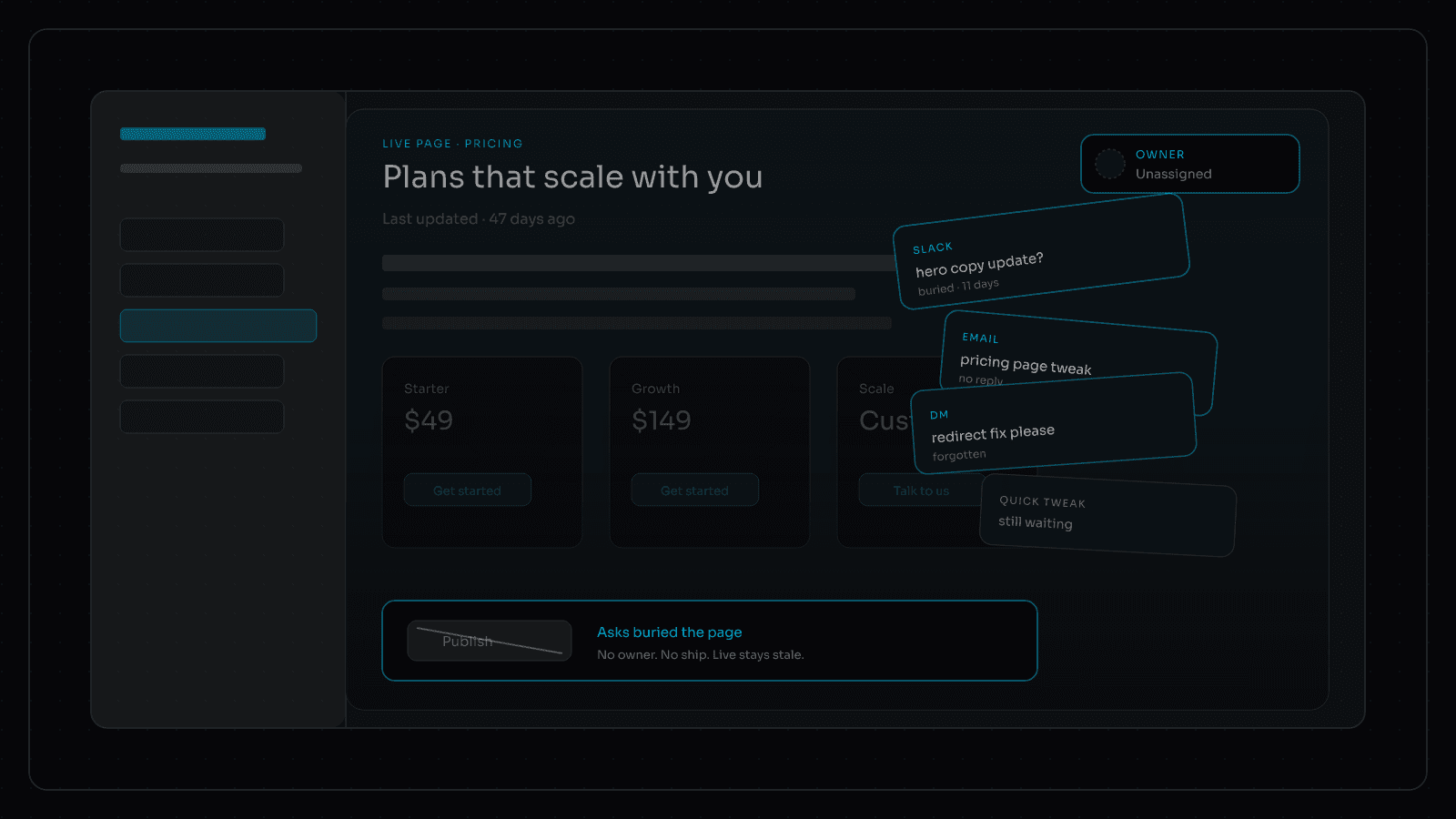
That lag is what people mean when they say the website is a bottleneck. Not because the edit is hard. Because there is no real website change request process. There is a pile of Slack messages and emails that get buried, forgotten, and chased weeks later.
What "change request" actually means
Forget the formal language for a minute.
A website change request is just an ask to make the live site match what the business needs right now. Marketing has the copy. Leadership wants progress. The page is still wrong.
If your team has no shared place for those asks, no clear owner, and no habit of moving them to live, you do not have website change management. You have inbox chaos.
The real problem is the lack of a system
Most teams do not start with a process. They start with a ping:
- A Slack message with half the context
- An email that sits unanswered
- A DM that disappears when the channel scrolls
- A "quick tweak" that expands into three more asks
There is no accountability. Nobody can see what is waiting, what is blocked, or who is supposed to ship it. Leadership asks for a status update and hears "in progress" with no date attached.
That is the bottleneck. Not the CMS. Not the contractor. The missing system.
What a workable website request process looks like
You do not need enterprise ceremony. You need a path that makes asks visible and finishable:
- One place to send the ask (not five channels)
- Enough detail up front: which page, what should change, what "done" looks like, who owns the answer
- A simple size check: tiny copy swap vs bigger page work
- A visible queue so leadership can see progress without chasing
- A human review before anything public goes live
That is the core of a website change request process. Clear intake. Visible work. Someone responsible for moving it.
Semi-automated helps. It does not replace people.
A customized, semi-automated system is the right move. Routing, reminders, drafts, and status updates can run with AI assistance so small changes do not wait on heroics.
Automation is not an excuse to leave the queue unattended.
Someone still has to watch the requests, ask the missing questions, unblock stuck work, and push finished edits live. A system without a human in it becomes another place for asks to die quietly.
How this plays out week to week
- Campaign owner sends one complete ask instead of a vague Slack ping
- The queue shows where it sits: waiting for detail, in build, in review, live
- A person on the ops side nudges incomplete asks and keeps the ship moving
- Leadership sees status without hunting through threads
- Next week's request reuses the same path instead of inventing a new email chain
Small website changes start compounding into trust instead of another status meeting.
What still breaks when nobody owns the middle
- The ask sits with a contractor while leadership wants progress today
- Assets arrive after someone marked it "done"
- Three people approve copy and nobody publishes
- A "quick fix" grows with no re-scope
- Staging looks right and production still shows the old offer
Those failures show up whenever Slack and email are doing the job of a website request process.
How this maps to Website Operations
We run Website Operations so upkeep is a system: content updates, redirects, platform hygiene, and performance checks with a human review before anything goes live. Pair that with a Website MCP Server and teams can request changes in plain language instead of fighting the CMS.
The website change request process stops being a bottleneck when intake is clear, the queue is visible, and a real person keeps the work moving.
The point for marketing leaders
If leadership cannot see where a website ask sits, you do not have a process. You have hope with a subject line.
Build the system. Keep a human in it. Ship the small changes on purpose.