How to Rank in Google's AI Overviews
How to rank in Google's AI Overviews for B2B: what gets cited, technical and content requirements, and a practical AI Overviews SEO checklist you can run.
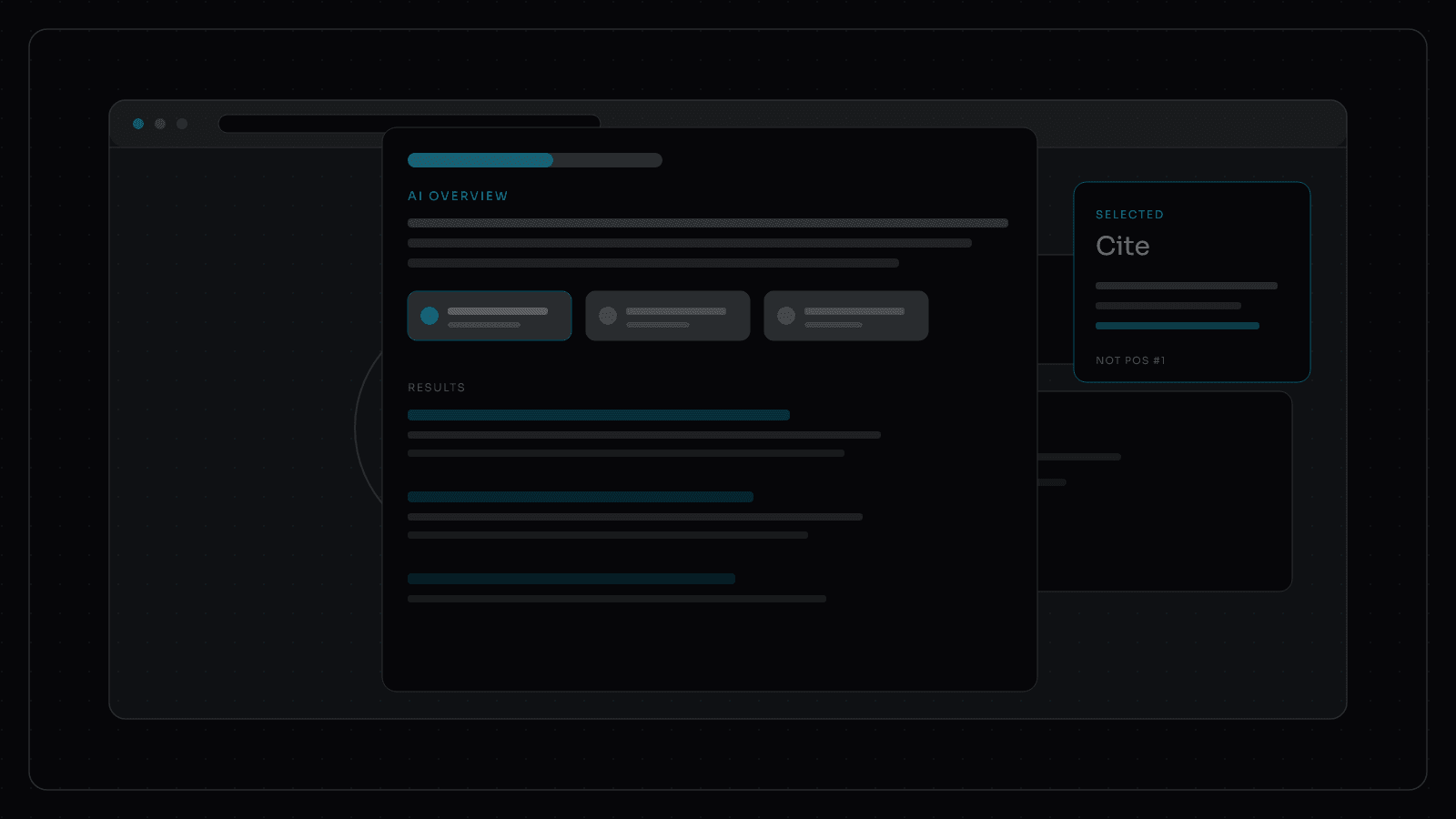
You do not "rank" in Google AI Overviews the way you rank a blue link. You get selected as a source the Overview trusts enough to cite, summarize, or surface beside the answer.
For B2B marketing leaders, that distinction matters. Classic SEO still decides whether you are eligible. AI Overviews SEO decides whether your page is clear, attributable, and useful enough to appear when Google synthesizes an answer above the results.
If your site is slow, vague, or thin on proof, you will keep ranking for some keywords and still miss the Overview. Fix the substrate, then structure pages for citation.
What Google AI Overviews are
AI Overviews are generated summaries that appear for many informational and commercial-investigation queries. Google pulls from the live web, compresses competing sources, and shows an answer with supporting links and attributions.
They are not a separate index you submit to. They sit on top of Search. Eligibility still depends on crawlability, relevance, and quality signals you already manage for organic search.
What changed is the unit of winning. The Overview optimizes for a confident synthesis, not a single document title in position one.
What gets cited or shown
Pages that tend to show up in or under AI Overviews share practical traits:
- A direct answer near the top that matches the query intent
- Stable entities: product names, categories, integrations, industries, geographies
- Evidence next to claims (methods, constraints, metrics, dated guidance)
- Headings that could stand alone as snippets
- Consistent facts across the page and related URLs
- Technical health: fast HTML, clean canonicals, structured data that matches what users see
Thin listicles, slogan-heavy service pages, and copy buried behind late client renders lose. So do pages that contradict themselves across the site. Models and Overview systems prefer sources they can attribute without guessing.
Technical requirements that still decide eligibility
AI Overviews SEO inherits the same failure modes as classic technical SEO.
Crawl and render
Primary copy should be available in initial HTML. Do not hide the answer behind tabs, late hydration, or infinite scroll if that is the content you want cited. Keep robots rules honest. Fix soft 404s and canonical conflicts.
Speed and stability
Core Web Vitals and stable layouts still matter. A high-performance website makes extraction cheaper and trust higher. Marketing pages that feel "done" in design tools but ship heavy client bundles often lose both conversions and Overview eligibility.
Structured data and internal links
Use schema that mirrors visible content. Do not invent offers in JSON-LD. Connect problem pages, method pages, and service pages with matching language so your entity graph is coherent. Overviews synthesize across the web; contradictory internal language weakens you.
Content requirements for B2B pages
Write for the job question, not the brand story first.
- Open with the one-sentence answer a buyer (and an Overview) should take away.
- Define the system or approach in plain language.
- Give criteria, steps, or a checklist a practitioner can reuse.
- Place proof beside claims.
- End with a clear next step.
That pattern helps humans scan and helps Google lift a clean citation. Keyword stuffing does the opposite.
For commercial pages, name who you serve, what you build, and what outcomes you measure. "We help modern teams grow" will not beat a page that states stack, constraints, and delivery model in concrete terms.
How this relates to classic SEO and AEO
Classic SEO optimizes for ranked documents. Answer engine optimization optimizes for cited statements across AI surfaces. Google AI Overviews sit at the intersection: still Search, still dependent on ranking signals, but scored for synthesis and attribution.
| Classic SEO habit | AI Overviews emphasis |
|---|---|
| Win position for a head term | Be a trustworthy source inside the synthesized answer |
| Broad topical coverage | Atomic answers with supporting depth |
| Keyword variants | Stable entity language and consistent facts |
| Click-through from blue links | Visibility when the Overview answers without a click |
You still need discoverability. You also need pages machines can quote. Treat Overview work as AEO applied to Google's SERP layer, not as a replacement for technical SEO or conversion-focused site engineering.
Checklist: how to rank in AI Overviews this week
Pick one money query where an Overview already appears, plus the page you want selected.
- Confirm the Overview exists and note which domains are cited.
- Write the one-sentence answer your page should contribute.
- Move that answer into the first screen of HTML, under a clear H1/H2.
- List five entities the page must reinforce and remove synonym soup.
- Place one proof block next to the primary claim.
- Fix crawl, speed, and canonical issues on that URL.
- Align schema and internal links with the visible copy.
- Re-check the query in an incognito session over several days. Compare clarity against cited competitors, not vanity impressions alone.
If a competitor appears and you do not, read their page like an extractor. Shorter definitions, nearer proof, and cleaner technical delivery usually explain the gap better than another AI-visibility vendor pitch.
Build the substrate, then compete for the Overview
How to rank in AI Overviews is mostly operational discipline on a site built for performance and clarity. Google still has to find you, trust you, and extract you. Marketing leaders who treat Overview visibility as a content trick on a fragile stack will keep watching competitors get cited.
STRS Dev builds high-performance B2B websites and content systems engineered for velocity, conversion, and the technical clarity Search and AI Overviews both require.