What Happens When You Stop Maintaining Your Website
An outdated website costs trust and pipeline when it no longer matches the company you are becoming. Spot the signs and close the gap.
An outdated website rarely fails in one dramatic moment. It fails by describing a company you no longer are.
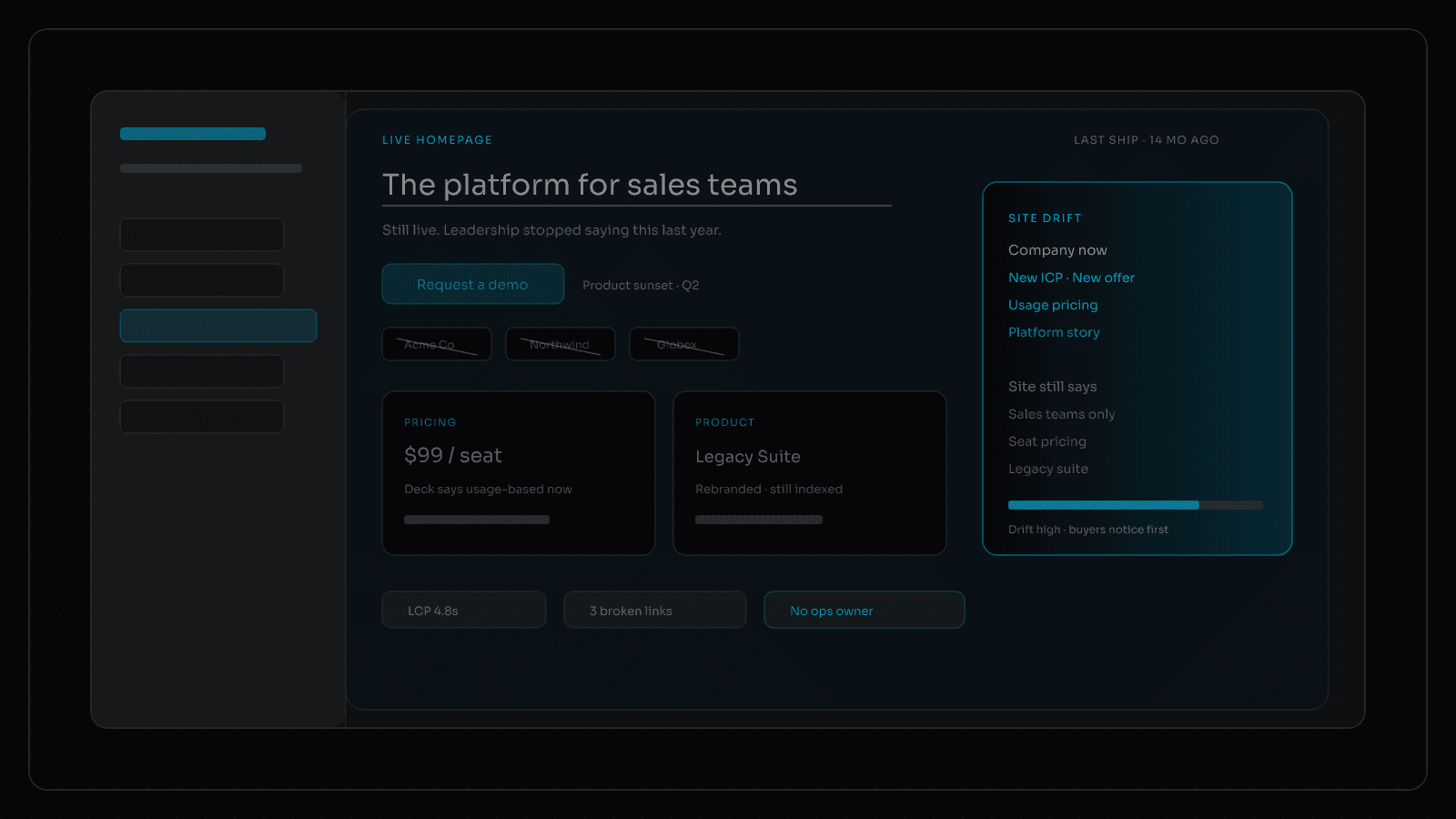
Marketing leaders feel it first in the sales cycle. A prospect lands on pricing that does not match the deck. A product page still leads with a feature you sunset last year. A "new" campaign sends traffic to a homepage that still talks like the company you were two planning cycles ago. Trust leaks before the first call.
Stopping maintenance does not mean the site goes dark. It means the operating system behind the site stops. Content freezes. Plugins rot. Redirects pile up. Performance drifts. The brand keeps moving. The site does not.
What "outdated website" actually means
People say outdated website when they mean one of three gaps:
- Message drift - the company repositioned, launched a line, or changed ICP, and the live site still sells the old story
- Ops drift - nobody owns updates, so broken links, expired CTAs, and stale proof sit in production for months
- Technical drift - Core Web Vitals slip, security patches lag, schema and SEO fields go stale, and search or AI answers start citing a thinner version of you
All three are outdated website risks. The first one is the one that costs pipeline fastest because buyers meet the wrong company.
Signs your website needs updating
You do not need a 40-page audit to know. Watch for these signs your website needs updating:
- Leadership describes the business one way in meetings; the homepage still describes another
- Pricing, packaging, or "how it works" pages lag the sales deck by more than a quarter
- Campaign landing pages reuse old proof, logos, or product names that sales already stopped using
- Broken links and redirects accumulate with no owner and no ship date
- Core Web Vitals or Lighthouse scores slide after "small" plugin and script additions
- Analytics still tracks pages and events that no longer map to the funnel you run
- Legal, brand, or product asks go into Slack and die there instead of reaching a publish queue
Any one of those is a warning. Several at once means the site is already working against you.
What happens when maintenance stops
Buyers lose confidence. An outdated website reads as operational neglect even when the team is excellent. Prospects compare your claims to what they can verify on the page. When those disagree, they assume the page is right and the pitch is soft.
Pipeline gets noisier. Marketing keeps buying traffic. Sales keeps explaining mismatches on calls. Conversion drops on money pages first: pricing, demo, contact, product. The cost looks like "ads are worse" when the landing experience is stale.
Search and AI answers lag the real story. If titles, schema, and canonical pages still describe the old offer, rankings and citations reinforce the outdated website. You train both Google and answer engines on yesterday's positioning.
Risk compounds quietly. Unpatched plugins, expired certificates, dead forms, and abandoned microsites do not announce themselves. They show up as a security scare, a failed form submit, or a redirect that dumps a buyer on a 404 during a launch week.
Why this keeps happening
Most teams treat the website as a launch artifact, not an operating system. A redesign ships. Applause. Then ownership dissolves into "whoever has CMS access this week." Without Website Operations (scheduled upkeep, clear owners, a human gate on publish), maintenance becomes optional busywork. Optional work loses to campaign work every time.
The ICP for this problem is not "we need prettier pixels." It is "the site no longer matches the company we are becoming." That is a maintenance and operations gap, not a brand mood board.
What good maintenance looks like
- Money pages stay aligned with current offers, pricing, and proof
- Content and technical updates ship on a cadence with named owners
- Broken links, redirects, and form failures get caught before buyers do
- Performance and SEO fields are checked the same week content ships
- Requests arrive in plain language and leave through a review gate, not a Slack graveyard
You do not need a full rebuild every time the company evolves. You need a system that keeps the live site honest.
How this connects to delivery
STRS Dev runs Website Operations as ongoing, AI-assisted maintenance with a human review gate: content updates, broken-link and redirect fixes, platform and security upkeep, and performance QA. The point is simple. Your site stays current. Your team stays in charge. The company you are becoming shows up on the page buyers actually read.