Headless CMS vs WordPress: What B2B Marketing Teams Actually Need
Headless CMS vs WordPress for B2B marketing: what teams actually need is content velocity, performance, and a publish path that does not depend on plugin debt.
Headless CMS vs WordPress is usually argued like a religion. Marketing leaders do not need a religion. They need a website they can change under campaign pressure, that stays fast after the third plugin, and that still ranks when SEO is not an afterthought.
The useful question is not "which CMS brand wins." It is what a B2B marketing team actually needs from the content layer: structured content, a front end that can perform, and a publish path that does not disappear into a contractor queue.
What the headless CMS vs WordPress debate usually gets wrong
Most roundups compare features in the abstract:
- Theme marketplace size
- Plugin counts
- Editor familiarity
- Hosting cost
Those matter. They are not the decision. Marketing leaders feel the decision when a landing page is late, Core Web Vitals slip after a plugin update, or a campaign microsite cannot reuse the same product proof the sales site already has.
Headless CMS vs traditional CMS is an architecture choice about where content lives and how the site consumes it. WordPress can be traditional (theme renders everything) or part of a hybrid. Headless means content is stored as structured data and delivered through an API to a separate front end. The label is less important than the operating model.
What B2B marketing teams actually need
Strip the buzzwords. Marketing needs five things from a CMS stack:
- Structured content that can power pricing, product, blog, and landing pages without rewriting the same facts three times
- Publish speed with clear ownership, preview, and a human review gate
- Performance headroom so campaign scripts and media do not torch LCP
- SEO and AEO control over titles, schema, canonicals, and page templates
- Integration with analytics and the tools the team already opens every Monday
A headless CMS for marketing earns its keep when those five are true. WordPress earns its keep when the team can keep them true without fighting the platform. Many teams cannot.
Where WordPress still wins
WordPress is not the villain. For some B2B teams it is still the right call:
- Content volume is modest and one or two people own the site day to day
- The team already knows the editor and will not wait on a rebuild
- Requirements are mostly blog + a few landing pages, not a multi-surface content system
- Budget prioritizes shipping now over re-platforming
If WordPress is kept lean (few plugins, disciplined theme, staging, performance budgets), it can work. The failure mode is the familiar one: plugin sprawl, theme debt, and every "quick fix" becoming a weekend rebuild.
Where headless earns the switch
Choose headless when marketing is blocked by the coupled site:
- You need one content model feeding web, microsites, and future agent or app surfaces
- Front-end performance is a hard requirement, not a Lighthouse screenshot hobby
- Developers want a modern stack (often Next.js) while editors still need a calm authoring UI
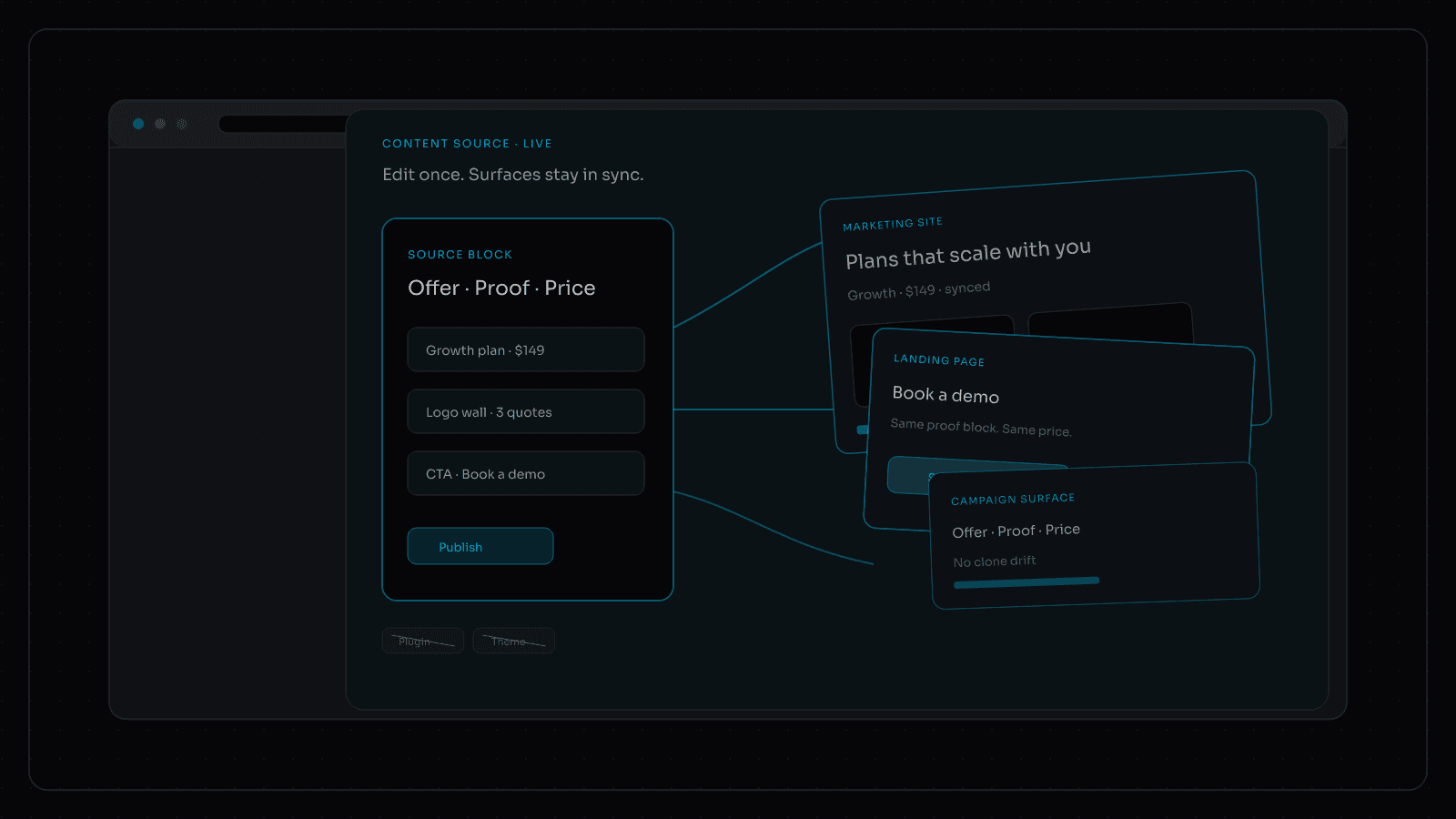
- Campaign velocity requires reusable blocks and fields, not page clones that drift out of sync
- You are done paying the tax of themes and plugins that own your roadmap
That is the real headless CMS vs WordPress trade: decouple content from presentation so marketing can publish and engineering can keep the front end honest.
Day-to-day: what "good" looks like
- An editor updates a product proof block once; pricing and demo landing pages both reflect it
- A campaign landing page ships from structured fields, not a one-off HTML dump
- Preview matches production closely enough that legal and brand can approve without surprises
- Core Web Vitals stay inside budget after a content-heavy launch because the front end owns the render path
- SEO fields and schema live with the content type, not as a plugin afterthought
If your current WordPress stack cannot do that without heroics, the debate is already decided. You need a better content system, whether the label says headless or not.
Guardrails before you migrate
A headless rebuild fails when teams chase novelty:
- Migrating every historical page before defining the content model
- Picking a CMS before defining templates and ownership
- Leaving editors without preview, roles, or a publish SLA
- Treating "headless" as a brand refresh instead of an operating change
Start with the money templates. Model the fields marketing actually edits. Keep a human gate on publish. Measure ship time and page performance the same week you cut over.
How this connects to delivery
STRS Dev builds high-performance websites with CMS architecture that matches how marketing ships: structured content, fast front ends, technical SEO, and integration with the rest of the stack. Whether you stay on a disciplined WordPress setup or move to a headless CMS for marketing, the standard is the same. The site has to perform, convert, and stay editable.