What Google's 2026 Algorithm Updates Mean for B2B Sites
Google algorithm update 2026 timeline for B2B: March and May core updates, spam passes, and what marketing teams should change on the site.
If your marketing team still treats every google algorithm update 2026 rumor as an emergency rewrite, you are burning sprint time. The useful move is simpler: know which named updates actually shipped, separate core from spam, and harden the B2B site systems those updates keep rewarding.
Google publishes ranking events on the Search Status Dashboard. Through early October 2026, the public record for Search ranking is already clear enough to plan against.
The 2026 timeline marketing leaders should know
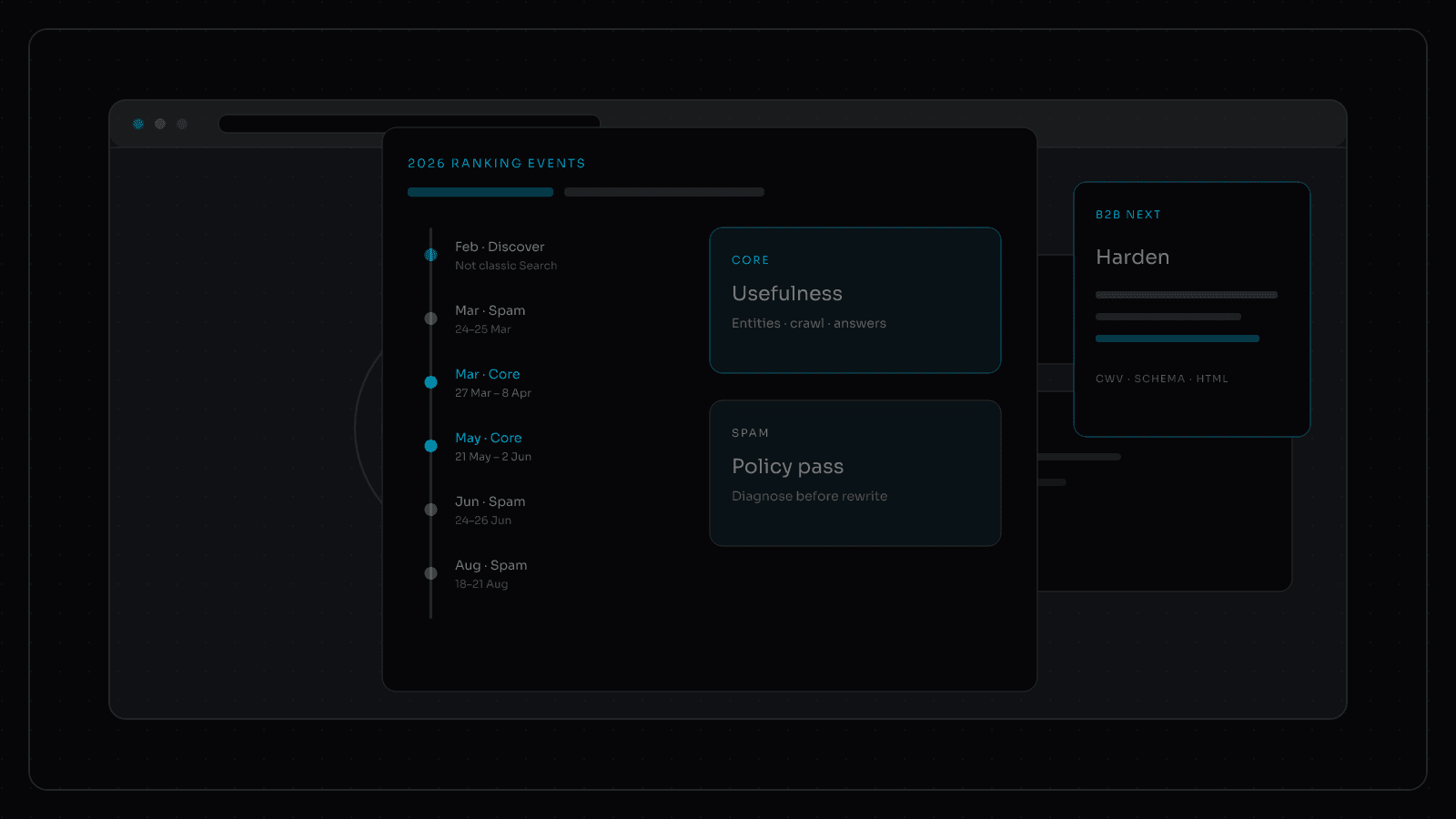
Named events from Google's dashboard (US/Pacific):
| Update | Started | Completed | Type |
|---|---|---|---|
| February 2026 Discover update | Feb 5 | Feb 27 | Discover (not classic Search) |
| March 2026 spam update | Mar 24 | Mar 25 | Spam |
| March 2026 core update | Mar 27 | Apr 8 | Core |
| May 2026 core update | May 21 | Jun 2 | Core |
| June 2026 spam update | Jun 24 | Jun 26 | Spam |
| August 2026 spam update | Aug 18 | Aug 21 | Spam |
That is the latest google algorithm update 2026 picture worth citing: two broad Search core updates (March, May), three spam passes (March, June, August), plus a Discover-scoped February update that should not be read as a classic blue-link ranking event.
What a google core update 2026 actually changes
A google core update 2026 event is a broad re-ranking pass. Google's public language stays consistent: surface more relevant, satisfying content. It is not a single "penalty" aimed at one tactic.
For B2B sites, the practical translation after March and May looked familiar:
- Thin service pages and interchangeable thought leadership lost ground to pages with clear answers and proof
- Entity confusion (inconsistent product and company naming) made pages harder to trust and cite
- Slow, hard-to-crawl templates struggled when useful competitors were also in the mix
- Content that existed mainly to chase keywords, not buyer questions, got less room
Core updates punish vagueness more than they punish missing a "hack." If your money pages still open with agency filler, the update did not invent that problem. It made it expensive.
Spam updates are a different job
Spam updates (March 24–25, June 24–26, August 18–21) re-score sites against Google's spam policies. Google framed the 2026 spam rollouts as normal, global, all-language passes. They are not the same lever as a core update.
If traffic dropped after a spam pass, review spam policies first: scaled content abuse, site reputation abuse, expired domain abuse, link spam, and related patterns. Do not "fix" a spam hit by rewriting a healthy product page for keywords. Fix the policy violation, then wait for systems to relearn compliance over months.
Mixing core and spam diagnosis is how teams ship the wrong sprint.
What B2B sites should harden next
Regardless of the next named google algorithm update 2026 event, the work that compounds:
- Make money pages answer-first. One clear claim, proof, next step.
- Keep Core Web Vitals real in production (LCP, INP, CLS). INP replaced FID years ago; stop reporting FID.
- Ship honest structured data that matches visible content. Skip retired FAQ/HowTo rich-result theater.
- Keep IA and naming consistent so people and models can map your entity graph.
- Prefer indexable HTML over client-only shells for critical content.
- Measure in Search Console with the named update windows above before you rewrite the roadmap.
That stack is also what earns citations in AI answers: useful pages that are crawlable, attributable, and specific.
How to respond when the next update lands
- Confirm the event on the Search Status Dashboard before you brief leadership.
- Label it core, spam, or Discover-scoped. Response plans differ.
- Wait until the rollout is complete, then compare like-for-like windows in Search Console.
- Change pages only where intent, usefulness, or policy compliance is clearly weak.
- Do not invent AI-only SEO rituals. Write for humans; synonyms are understood.
STRS Dev builds high-performance websites engineered for velocity, technical SEO, and structured data that matches what buyers see. That is the durable answer to google algorithm update 2026 volatility: a site worth ranking and citing when the next named pass lands.