Four Systems, One Website: How AI-Powered Sites Compound
A marketing website system is four connected pieces: perform, report, convert, connect. How treating the website as infrastructure compounds for B2B ops.
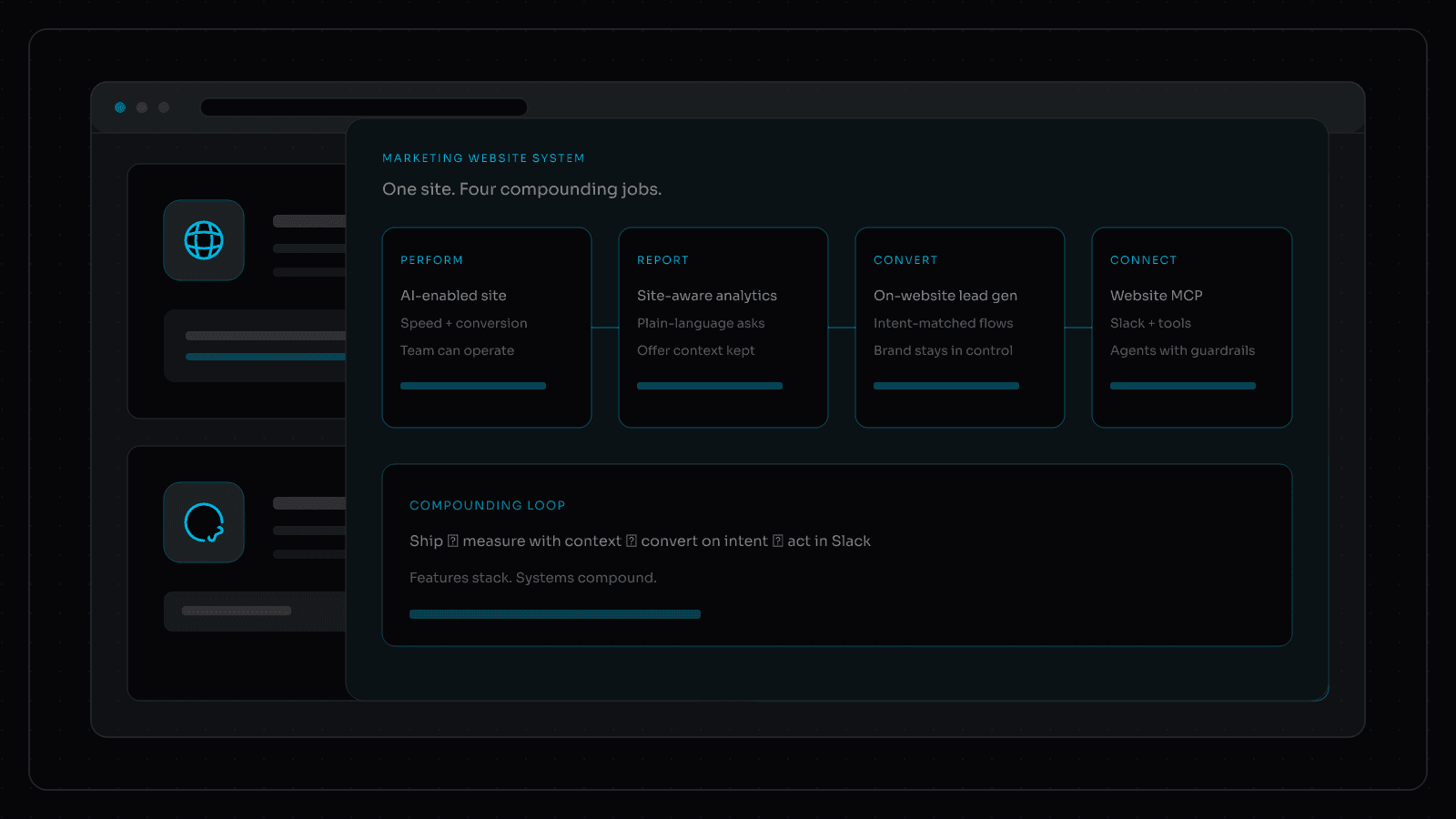
A marketing website system is not a prettier homepage plus another SaaS logo in the footer. It is four jobs that share one surface: the site performs, it reports with real context, it converts on intent, and it connects to the tools your team already uses. Buy those jobs as disconnected features and you get busywork. Wire them as a website as infrastructure and the work compounds.
That is the shift B2B ops leaders need when the site is still treated like a publish-only surface with plugins bolted on.
The publish-only trap
Most stacks grow by accident:
- A redesign that looks modern and still cannot answer a pipeline question
- A dashboard that reports traffic without knowing which offer changed
- A form vendor that owns the lead and none of the site context
- A chat widget that talks over brand voice instead of taking action
Each purchase solves a local pain. Together they create a connected website in name only. Marketing still waits on tickets. Ops still reconciles exports. Nobody owns the system.
Four systems that compound
Treat the website as the hub. Four systems do the jobs that used to live in separate tools.
1. Perform: AI-enabled websites
The foundation is a custom high-performance site your team can operate. Distinct positioning. Indexable HTML. Core Web Vitals that hold in production. Content and offers you can change without a sprint queue. Without this base, every other tool is decorating a weak surface.
2. Report: analytics with site context
Reporting only matters when it knows what the site actually shipped. Campaign changes, page intent, and offer history should sit next to the numbers. A marketing website system answers "what moved pipeline" in plain language, not "which UTM survived the export."
3. Convert: lead gen on the site
Capture belongs on your domain, matched to intent. Rigid third-party popups and bolted-on widgets leak context and brand control. Conversion workflows should reuse the same claims, proof, and routing rules as the rest of the site.
4. Connect: Website MCP Server
Integration is how the site stops being a dead end. Slack, CRM, internal tools, and agents need a governed layer into site truth. A connected website means operators can ask and act without another fragile Zap chain.
Alone, each system is useful. Wired together, they stop being features and start being infrastructure.
What compounding looks like day to day
- A page ships; reporting already knows the template and offer
- A lead converts; routing uses the same intent model as the page
- An agent answers from brand and product rules, not a prompt vacuum
- Ops changes copy or a CTA without waiting on an agency queue
- Next quarter builds on last quarter's instrumentation instead of starting over
That flywheel is why we talk about a website as infrastructure. Speed compounds. Context compounds. Operating leverage compounds.
What has to be true underneath
Compounding needs guardrails, not more tools:
- One source of truth for offers, pages, and claims
- Performance and crawlability as shipping constraints, not cleanup
- Human ownership of positioning and proof; AI acceleration on production and ops
- Integrations that are governed, observable, and reversible
- A team that can operate the stack without a ticket for every change
If those are missing, adding another widget increases noise. It does not create a marketing website system.
How this maps to STRS Dev Solutions
We build AI-powered website solutions as a connected set: AI-Enabled Websites, analytics reporting, on-website lead gen, and a Website MCP Server. Start where the gap hurts most. Plan for the other three so each ship raises the ceiling instead of adding another silo.
The overview lives on Solutions: perform, report, convert, and connect on one site your team can run.
The point for B2B ops leaders
If your site still feels like a publish-only homepage with a pile of vendor receipts, you do not need another feature. You need a marketing website system: four jobs, one connected website, infrastructure that compounds.
Features stack. Systems compound.