What the First 30 Days of a Website Jumpstart Looks Like
A practical 30-day website jumpstart and audit checklist: fix money pages, speed, tracking, SEO/AEO, and ownership so the next campaign can trust the site.
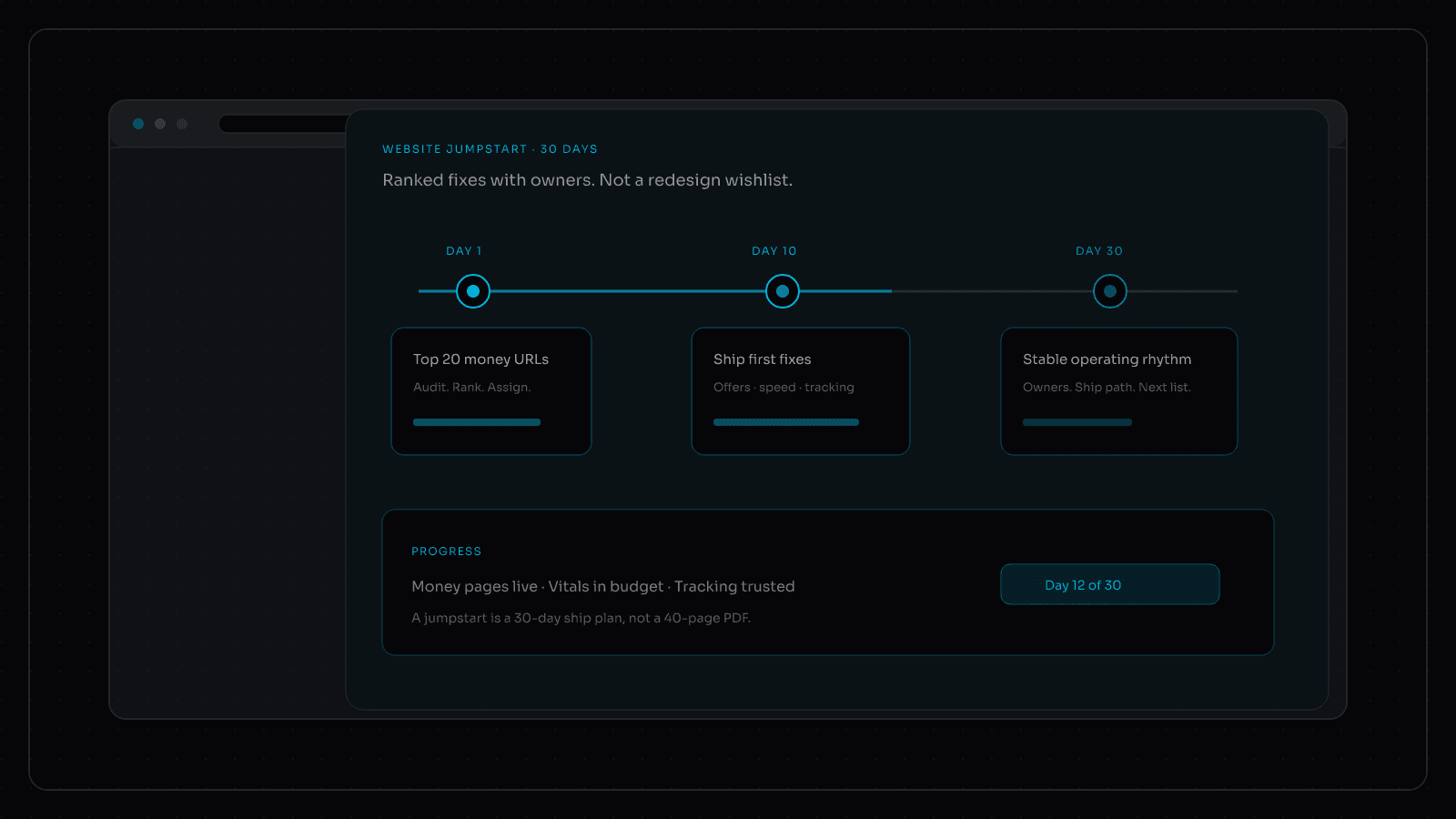
The first 30 days of a website jumpstart are not a redesign. They are a ship plan.
Most teams open planning season with a backlog that could fill a year: new homepage, brand refresh, CMS migration, AI chatbot. None of that protects pipeline next month. A website jumpstart answers a narrower question: what do we fix in the next 30 days so money pages convert, load, and report honestly?
Treat it like a website audit checklist with owners and dates. Skip vanity pages. Start where revenue feels the site.
What a 30-day website jumpstart is for
A website jumpstart is a short operating rhythm, not a strategy deck.
Days 1–5: see the truth. Days 6–20: ship the highest-leverage fixes. Days 21–30: lock ownership and the next list so the site does not slide back into Slack chaos.
You are not trying to polish everything. You are trying to make the paths marketing already pays for trustworthy.
Website audit checklist: five places to look first
Use this as a practical website audit checklist. Rank by revenue influence, not by who yelled loudest in the last meeting.
1. Money pages and offers
- Pricing, demo, and primary landing pages still match the live offer
- CTAs go somewhere real, with a clear next step
- Proof (logos, quotes, case numbers) is current
- Old campaign URLs redirect or update instead of 404-ing into confusion
If paid and outbound traffic hits stale copy, you are paying to lose trust.
2. Speed and Core Web Vitals
A website performance review in the first two weeks beats an emergency rebuild after a campaign launch.
- Check LCP, INP, and CLS on the homepage and top landing pages
- Strip scripts you no longer need
- Compress hero media and lazy-load what is below the fold
- Confirm staging and production share the same performance budget
Fast enough for a Lighthouse screenshot is not the same as fast enough under campaign tags.
3. Tracking and attribution
If analytics cannot answer what worked last quarter, the next campaign plan is guesswork.
- Key conversions fire once and map to the CRM fields you care about
- UTM discipline is written down, not tribal knowledge
- Broken tags, duplicate pixels, and dead events are gone
- Soft converts (newsletter, content) are not mixed into hard-convert reporting
You cannot run a serious website performance review without clean measurement.
4. SEO and AEO readiness
- Titles and meta descriptions still match the page intent
- Canonicals and redirects are not fighting each other
- Schema on money templates is valid and current
- Important answers are written as clear, quotable passages (not buried in PDFs)
Search and AI answers both reward pages that state the point early and keep facts consistent.
5. Content freshness and ownership
- Pages that still rank or convert have an owner
- Stale posts that contradict the product are updated or noindexed
- Legal/compliance footers and disclaimers match current reality
- There is a path to ship small fixes without waiting on a contractor queue
A website jumpstart that ends with a list and no owner is just documentation.
How the first 30 days actually run
Days 1–5: pull the top 20 URLs by revenue influence (organic, paid, sales-assisted). Walk the conversion paths on mobile and desktop. Note friction, not opinions.
Days 6–10: run Core Web Vitals and tag audits on those URLs. Rank fixes that unblock the next campaign.
Days 11–20: ship. Offers, redirects, form destinations, script debt, and broken events first. Leave the homepage redesign for a real project.
Days 21–30: assign owners and ship dates for the leftovers. Write down the operating path so the next ask does not restart in Slack.
You do not need a 40-page audit PDF. You need a ranked list and people accountable for closing it.
What "good enough at day 30" looks like
- Primary offers match live messaging
- Top landing pages clear a performance budget under real tags
- Conversion events match how sales defines a lead
- Dead campaigns redirect instead of confusing buyers
- Someone owns the next round of fixes
That is a website jumpstart that protects pipeline. Everything else can wait for a planned rebuild.
How this connects to an AI-enabled website
An AI-enabled website makes the next 30 days smaller. Structured content, performance by design, and workflows your team can operate mean the audit list shrinks. Pair that with Website Operations so the fixes do not die in Slack.
The point of a jumpstart is not a prettier backlog. It is a site your next campaign can trust.