Does llms.txt Actually Do Anything? An Evidence-Based Take
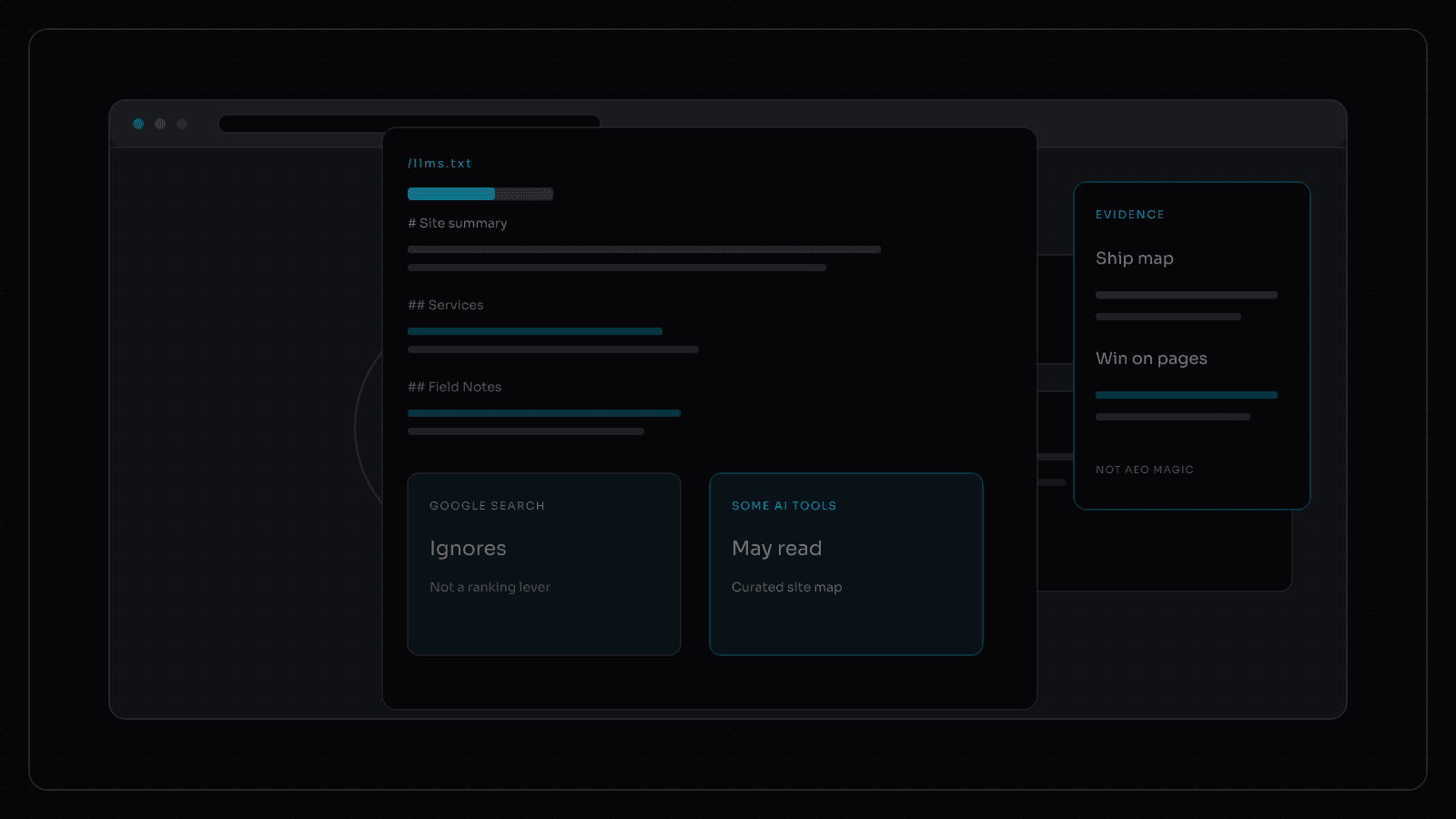
What is llms.txt, does it work, and which llms.txt best practices matter? Honest take: Google Search ignores it; some AI tools may use it.
Short answer: llms.txt is a useful site index for some AI tools, not a Google ranking lever. If your plan is "ship llms.txt, climb AI Overviews," you are solving the wrong problem.
What is llms.txt? It is a plain-text file at /llms.txt that follows the llmstxt.org convention: a short site summary plus curated links with descriptions. Think of it as a human-readable sitemap written for assistants, not a secret handshake with Google Search.
What llms.txt does and does not do
Does:
- Give crawlers and assistants a curated map of important URLs
- State what the site is about in one place
- Stay cheap to maintain when generated from your route inventory
Does not:
- Influence Google Search rankings
- Guarantee AI Overview citations
- Replace crawlable HTML, schema that matches the page, or clear answers
Google has been clear enough in practice and guidance that llms.txt is not part of Search ranking. Treat claims that it is a Google AEO switch as marketing, not evidence.
Why the file still shows up in llms.txt best practices
Search demand for "what is llms.txt" and "llms.txt best practices" is real because product and SEO teams want a control surface for AI discovery. The honest best practice set is narrow:
- Keep it accurate. Stale links are worse than no file.
- Lead with a one-paragraph site description a stranger could quote.
- Group URLs by intent (services, solutions, proof, notes), not by CMS folder names.
- Generate it from the same source of truth as your sitemap when you can.
- Do not stuff keywords or invent pages you would not show a human.
- Pair it with indexable pages that already answer questions clearly.
That is the whole job. llms.txt best practices are editorial hygiene, not a new ranking system.
Where evidence is thin
Public evidence that major assistants require llms.txt is limited. Some tools and agent frameworks fetch it when present. Others ignore it and rely on normal crawling, sitemaps, and retrieval over HTML.
So the evidence-based stance is:
- Shipping llms.txt is low cost if automated
- Expectation management matters more than the file itself
- Citation wins still come from indexable content, entity clarity, speed, and trust
If you skip technical SEO and clear answers, an elegant /llms.txt will not save you.
What to build instead of an llms.txt obsession
For SaaS and B2B product teams, the stack that actually moves AI and classic search looks familiar:
- Fast, crawlable pages on a high-performance website
- Honest structured data that matches visible content
- Answer-first sections that stand alone when quoted
- Consistent organization and service naming
- A maintained sitemap, robots policy, and RSS where useful
llms.txt can sit on top of that stack as a courtesy map. It should not become the project.
A practical checklist for this week
- Open
yoursite.com/llms.txt. If it 404s, decide whether generation is worth an hour. - If it exists, diff it against your live nav and sitemap. Delete ghosts.
- Rewrite the intro so a model (or a new hire) understands the business in three sentences.
- Confirm money pages are indexable and answer-first without relying on the file.
- Re-read any internal doc that claims llms.txt affects Google. Correct it.
Ship the map. Win on the pages.
Does llms.txt actually do anything? Sometimes, for tools that choose to read it. It does not replace the website work that earns rankings and citations. STRS Dev builds high-performance websites with technical SEO, structured data, and route-driven indexes (including llms.txt) so the map stays honest as the site grows.
Keep the file. Do not bet the roadmap on it.