Core Web Vitals in 2026: What Actually Moves Rankings
Core web vitals in 2026 still mean LCP, INP, and CLS. How a real core web vitals assessment uses field data, and what actually moves rankings.
Core web vitals still move rankings in 2026. Not as a magic lever, and not because a Lighthouse screenshot looked green on a quiet laptop. Google's page experience signals still lean on field data for LCP, INP, and CLS. Teams that chase lab vanity while shipping heavy heroes, chat widgets, and layout thrash are optimizing the wrong report.
If you need a core web vitals assessment that actually informs roadmap work, start with real users. Then fix the three metrics that still matter.
The 2026 stack: LCP, INP, CLS
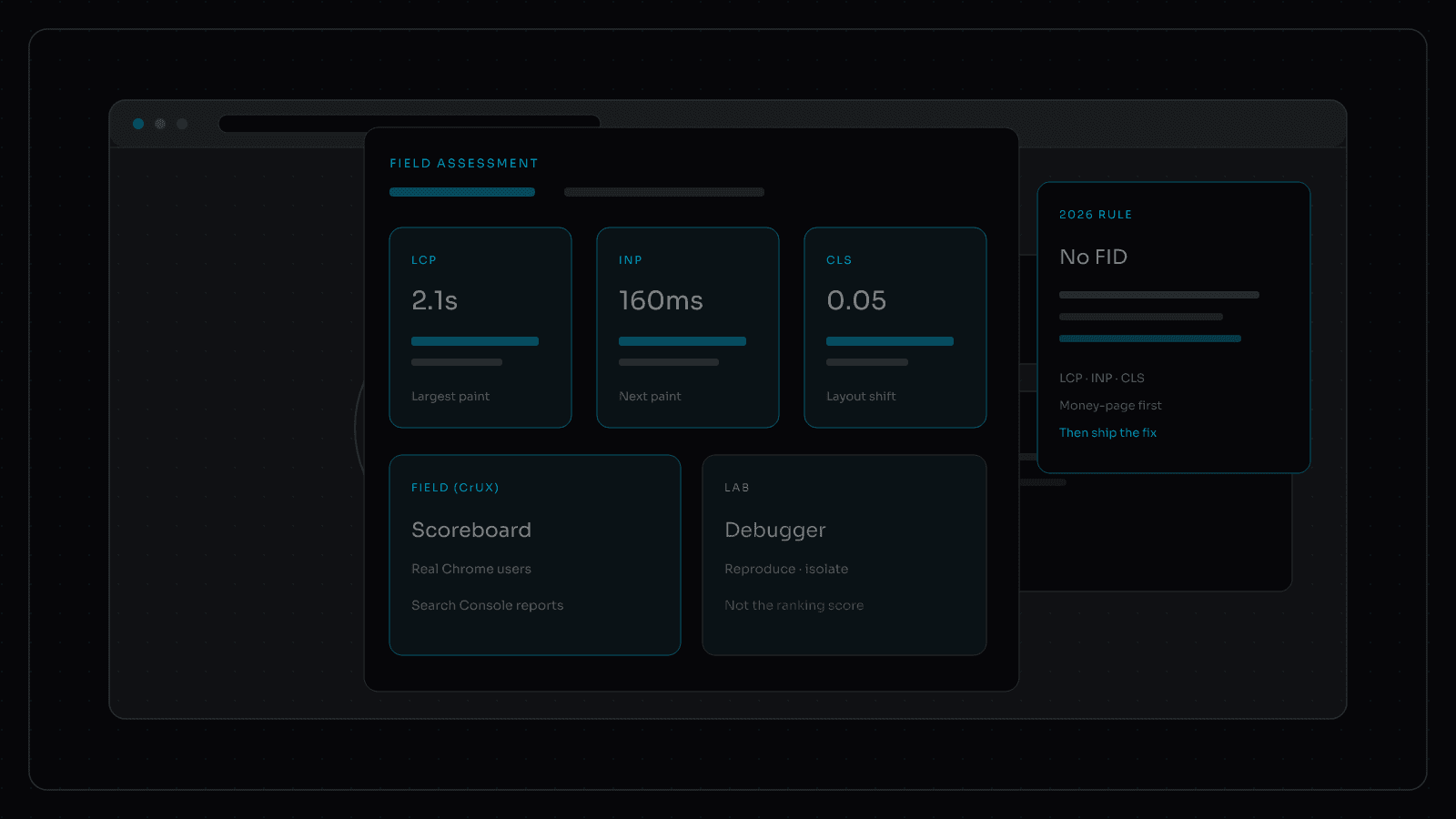
Forget FID. Interaction to Next Paint replaced it. A modern core web vitals inp review is about how long the page stays unresponsive after a click, tap, or keypress. Largest Contentful Paint is still the load story. Cumulative Layout Shift is still the stability story.
That is the full set for ranking-adjacent page experience:
- LCP - how fast the main content appears
- INP - how quickly the UI responds to interaction
- CLS - how little the layout jumps while people read and click
Anything else is useful diagnostics. It is not the Core Web Vitals trio.
Field data beats lab theater
A serious core web vitals assessment pulls CrUX (Chrome UX Report) and Search Console experience reports for the URLs that earn money. Lab tools help you reproduce a failure. They do not decide whether the origin passes the thresholds Google uses for real Chrome users.
Practical rules:
- Treat origin-level and URL-level field data as the scoreboard
- Use Lighthouse and WebPageTest to find the cause, not to celebrate a synthetic win
- Segment by template: homepage, pricing, product, blog, and app shell often fail for different reasons
- Watch mobile first; B2B ops teams still ship desktop-tuned pages that fail on mid-tier phones
If field LCP is poor and lab LCP looks fine, you have a caching, CDN, third-party, or real-device problem. Fix that. Do not rewrite the content calendar.
What actually moves each metric
LCP
Prioritize the true LCP element. Preload the hero image or critical font only when it is on the critical path. Serve modern formats, sized correctly, from a fast origin or CDN. Avoid late discovery from CSS background tricks and client-only renders for the first paint of money pages.
Server-rendered HTML and disciplined next/image usage beat another design pass on the same oversized PNG.
Core web vitals inp
INP is a main-thread problem. Reduce long tasks on interactive templates. Defer non-critical JavaScript. Audit tag managers, chat embeds, and analytics that wake up on every page. Prefer lean event handlers over giant framework hydration on marketing pages that only need a form and a CTA.
If core web vitals inp fails after a marketing launch, look at what you added last: the widget, the A/B script, the personalization layer.
CLS
Reserve space for images, embeds, banners, and late-loading UI. Set dimensions. Avoid inserting cookie bars and announcement strips above content after first paint without a reserved slot. Fonts should not reflow the H1 into a new line after swap.
Stability is a design system constraint, not a one-off CSS hotfix.
How to run a core web vitals assessment
- Pull Search Console Core Web Vitals / experience reports for key templates
- Confirm CrUX field status for LCP, INP, and CLS on mobile and desktop
- Reproduce the worst URLs in lab with the same device class and throttling
- Attribute failures to media, JS, fonts, or layout, not to "SEO" as a vague bucket
- Ship one fix per failure mode; re-check field data after enough traffic, not overnight
- Keep performance budgets in CI so the next campaign does not undo the win
That sequence is what separates teams that move rankings from teams that screenshot green labs.
What does not move rankings
- Obsessing over a 100 Lighthouse score while CrUX stays red
- Measuring FID or treating it as current guidance
- Blaming keywords when money pages take four seconds to paint the hero
- Shipping INP regressions with every new third-party tag
- Declaring victory from staging without production field coverage
Core web vitals are a ranking and experience input. They are not a substitute for crawlable content, clear offers, or honest structured data. They also are not optional cosmetics.
The point for B2B ops leaders
If pipeline pages feel slow or jumpy, buyers leave and bots notice. Fix LCP, INP, and CLS where revenue happens. Use field data as the assessment. Use lab tools as the debugger. Keep the stack lean enough that the next campaign does not buy the problem back.
STRS Dev builds high-performance websites with Core Web Vitals discipline baked into delivery, not bolted on after launch. If your origin fails field thresholds while the slide deck says the site is fast, start with this assessment.