What's a Good B2B Website Conversion Rate? (And How to Beat It)
What counts as a good B2B website conversion rate, how benchmarks break down, and why high-intent traffic plus landing page substance beat CTA tweaks.
A good B2B website conversion rate is not a single industry number you can paste into some slides. It is a definition first, then a benchmark. Visitor to newsletter is not the same as visitor to demo request. Pricing-page conversion is not the same as sitewide conversion. Until those definitions match, every "average" you chase is noise.
Marketing leaders ask for the average B2B website conversion rate because it's the best way to measure the success of the website. Use benchmarks to gauge what is normal. Then blow them out of the water by fixing what actually drives conversions: who shows up, and what they read when they land.
What "conversion" has to mean
Pick one primary conversion for the question you are answering:
- Soft convert: email capture, content download, waitlist
- Mid convert: contact form, chatbot qualified handoff, pricing request
- Hard convert: demo booked, trial started, sales-ready lead
Mixing those into one sitewide rate hides the truth. A site can look "average" overall while the demo landing page underperforms, or look weak overall while paid landing pages convert well. B2B conversion rate benchmarks only help when the numerator and denominator match the primary goal.
Average B2B website conversion rate ranges
Public industry roundups usually land in the same band for B2B visitor-to-lead:
- Rough average: about 2% to 3% sitewide for many B2B lead-gen sites
- Soft conversions (content / newsletter): often higher, sometimes mid-single digits when the offer is clear
- Hard conversions (demo / sales form): often 1% to 5% depending on traffic quality and friction
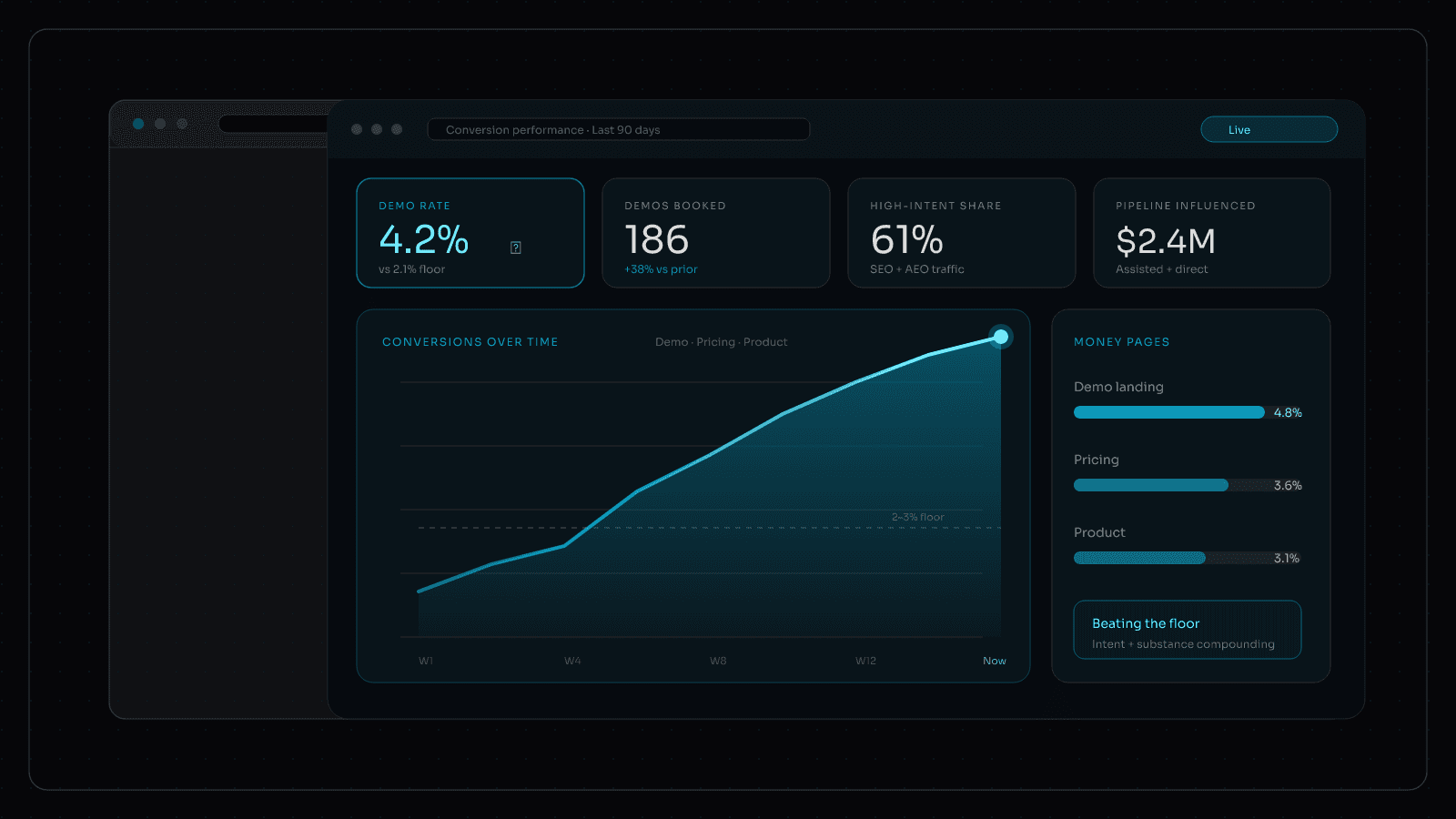
- Strong performers: frequently 3% to 5%+ on money pages when intent is matched and the path is short
Treat those as directional B2B conversion rate benchmarks, not law. What matters is your definition, your traffic mix, and whether money pages clear a bar your peers would respect.
If your paid demo landing page sits under 1% with qualified traffic, you have a page problem. If your blog converts at 0.3% into newsletter while demos clear 4%, you may not have a crisis. You have different jobs on different templates.
Why averages mislead
- Traffic mix - Brand search converts differently than cold paid.
- Page mix - Homepage and blog dilute rates. Decision-makers care about pricing, product, and request-demo templates.
- Friction and speed - Long forms and slow LCP suppress hard converts even when interest is real.
- Attribution gaps - If chat, forms, and analytics disagree on what counted, your reported rate is fiction.
Benchmarking without segmentation trains the wrong response: redesign everything when one template is broken, or A/B a button while the wrong audience walks through the door.
Conversion starts before the landing page
Most "how to optimize a page for conversion" advice is table stakes: clearer CTA, fewer fields, faster load. Useful. Incomplete.
High-intent traffic is the real multiplier. More visitors who are already ready to buy, book, or shortlist will move your B2B website conversion rate faster than another hero-button test. That means a solid SEO and AEO strategy aimed at people with commercial intent, not vanity volume.
- Target queries where the searcher wants a vendor, a demo, a comparison, or a concrete answer they can act on
- Structure pages so search and answer engines can cite you for those high-intent questions
- Send paid and organic traffic to the template that matches the ask, not a generic homepage dump
- Measure convert rate by traffic quality, not only by page design version
If the room is full of tire-kickers, no CTA polish saves the meeting. If the room is full of buyers, a good page finally has a chance.
Content quality beats conversion theater
Landing page design patterns matter. Landing page substance matters more.
Too many marketing teams ship quantity: more pages, thinner copy, recycled proof, CTAs with nothing underneath. A landing page can have every conversion design element and still fail if the content does not speak to what prospects care about.
What we see working:
- Well-planned landing pages with meaty content prospects actually relate to
- Specific proof tied to the offer, not generic "trusted by teams" filler
- Clear problem framing, outcome language, and objections answered on the page
- Fewer pages that go deep beats a pile of thin campaign microsites
Design without substance is theater. Substance without a path to act is a white paper. Conversion needs both, fed by the right traffic.
How to beat a good B2B website conversion rate
1. Attract high-intent traffic on purpose
Build SEO and AEO around commercial and mid-funnel intent. Stop celebrating traffic that never could convert. Pair acquisition with the template that matches the query.
2. Build landing pages with substance
Plan the page around the buyer, not the layout kit. Meaty content, relevant proof, and an offer that matches why they arrived. If the copy is thin, fix that before you A/B the button color.
3. Instrument money pages
Report conversion by template: homepage, pricing, product, demo, campaign landing pages. Set a target per template. Compare against the average B2B website conversion rate only after you filter to comparable goals.
4. Match offer to intent and cut friction
Cold traffic wants proof and a lighter ask. High-intent traffic wants a short path to talk to sales. Fewer fields. Clear outcome. Visible trust near the CTA.
5. Fix speed and align analytics
Treat Core Web Vitals as conversion work. Use one event name for "demo booked" and one rule for assisted vs direct. If marketing and sales cannot agree on the numerator, no benchmark will save the meeting.
What "beating it" looks like in practice
- SEO and AEO shift mix toward high-intent queries; demo landing page rate rises without a redesign
- A thin campaign page gets rewritten with substance prospects care about; convert rate jumps while traffic stays flat
- Paid stops dumping cold traffic onto a hard-convert form that needed warmer intent
- Weekly reporting shows template-level rates next to traffic quality, not one blended vanity number
That is how B2B conversion rate benchmarks become useful: as a challenge to traffic quality and page substance, not a slogan for the whole domain.
How this connects to delivery
STRS Dev builds high-performance websites as conversion systems: technical SEO and AEO for high-intent demand, landing pages with substance, clear offers, and measurement that matches how marketing actually sells. If your team needs a credible answer to "what is a good B2B website conversion rate" and a plan to beat it, start with definitions, money-page benchmarks, the right traffic, and content worth converting on.