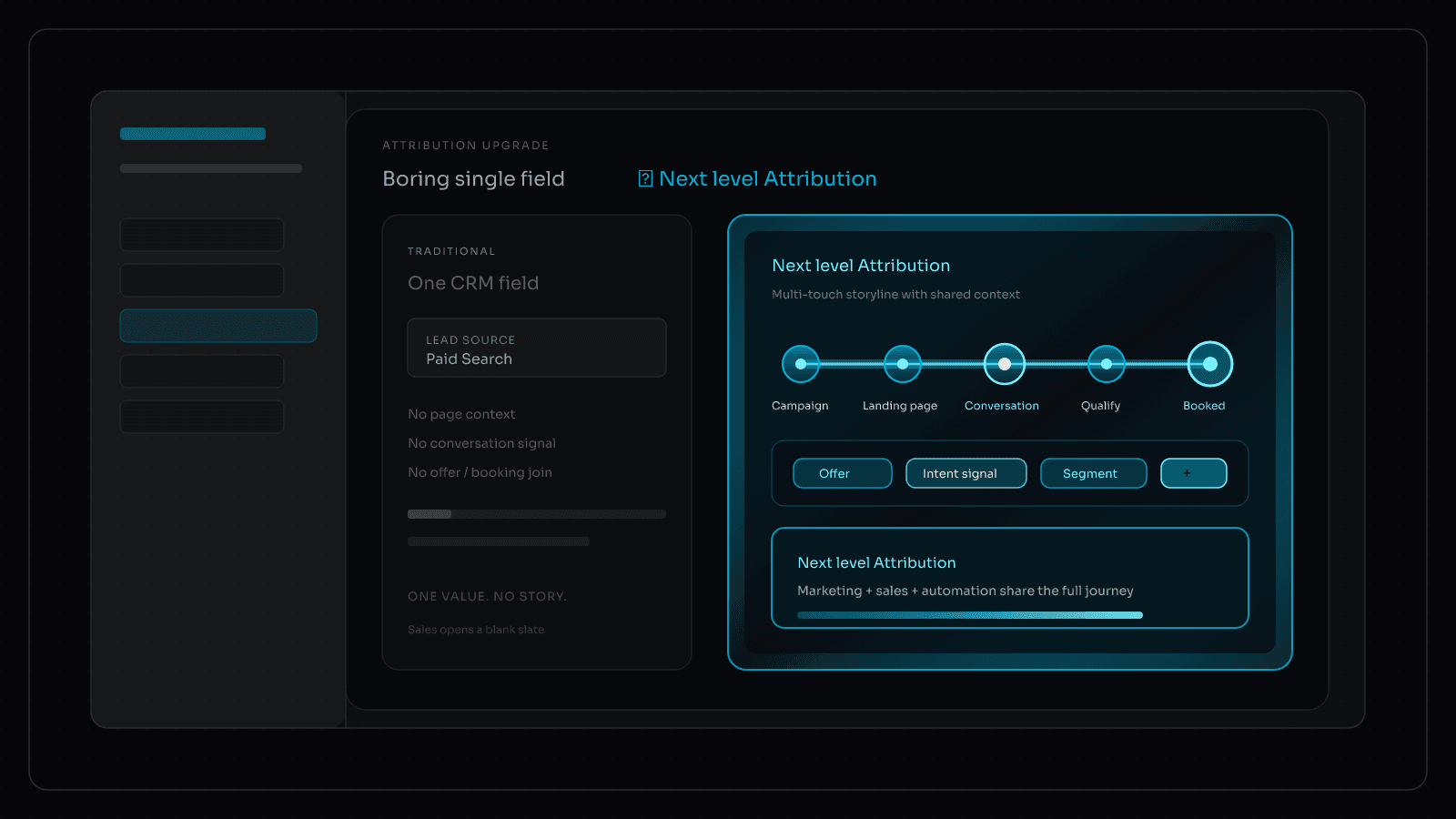
Lead Source Attribution Beyond a Single CRM Field
Skilled on-site agents capture conversation context marketers can use. Lead source attribution becomes a storyline, not one static HubSpot or Salesforce field.
Marketers already understand lead source attribution. The frustration is that most stacks still treat it like one static field in HubSpot or Salesforce: Paid Search, Organic, Partner. That label rarely explains why the meeting booked, what the prospect cared about, or which page and offer did the work.
A connected marketing stack raises the bar. Skilled on-site agents can talk with prospects, gather real context, and pass that story into analytics and CRM so integrated reporting is useful to marketing automation and sales, not just another export.
Attribution marketers already trust vs what they get
Traditional attribution answers a narrow question: which channel touched the contact. Useful. Incomplete.
What marketers actually ask on Monday:
- Which campaign and landing page created the demo?
- What objections or buying signals showed up in the conversation?
- Did sales get enough context to run a better first call?
- Can automation route and score from more than a source dropdown?
When the answer lives in a chat transcript, a CRM note, and a UTM string that never joined, attribution feels broken even when the field is filled.
What skilled agents add
A skilled agent is not a form with better copy. It interacts with the prospect on your site and can attach richer context to the same lead event:
- Campaign and creative that brought them in
- Landing page and offer they saw
- Qualification answers mapped to segments sales already uses
- Intent signals from the conversation, not only a checkbox
- Booking outcome tied to a stable lead ID shared with CRM and reporting
That is lead source attribution with a storyline. Integrated reporting can show which journeys booked and why, instead of which UTM string survived a zap.
Day-to-day for marketing and sales
- A visitor hits a paid landing page; the agent already knows the campaign
- The conversation captures role, timeline, and product interest in fields reporting can use
- A meeting books; marketing sees source, page, offer, and conversation context in one row
- Sales opens the record with more than "Paid Search" and a bare email
- Automation can score and route from richer signals without a spreadsheet reconcile
Marketing automation gets smarter because the inputs are richer. Sales gets sharper because the first call starts with context. That compounding loop is the point of a connected marketing stack.
Where teams still lose the story
- Agent books from a paid landing page; CRM only stores email and meeting time
- Analytics sees the session; reporting never sees the booking
- Sales asks which campaign worked; marketing opens three tabs and guesses
- Attribution stays a single picklist while the useful story sits in a chat log nobody joins
- A new chat vendor ships without required context fields; nulls spread quietly
Those failures are predictable whenever capture and reporting do not share a contract.
Guardrails that keep attribution useful
Wiring an agent to a webhook is not enough. You need:
- Shared definitions of campaign, source, page, and offer across site, agent, CRM, and reports
- Event schemas that refuse to fire without required attribution and conversation fields
- Clear ownership of assisted vs direct pipeline
- Observability when the join fails, not silent blanks in the dashboard
- A reporting layer that understands website and conversation context, not only ad platform exports
Without those, AI lead gen accelerates volume and accelerates blind spots.
How this maps to STRS Dev Solutions
We build on-website lead gen so skilled agents live on your domain with intent matched to the page. We build custom analytics reporting so answers include website context and third-party joins in plain language. Pair them and attribution becomes a storyline marketing and sales can both use.
A Website MCP Server keeps that loop operable in Slack and internal tools without another fragile integration chain.
The point for marketing leaders
If lead source attribution is still one static CRM field, you are leaving the conversation on the table. Skilled agents can capture more context. A connected marketing stack should make sure reporting and sales actually get it.